


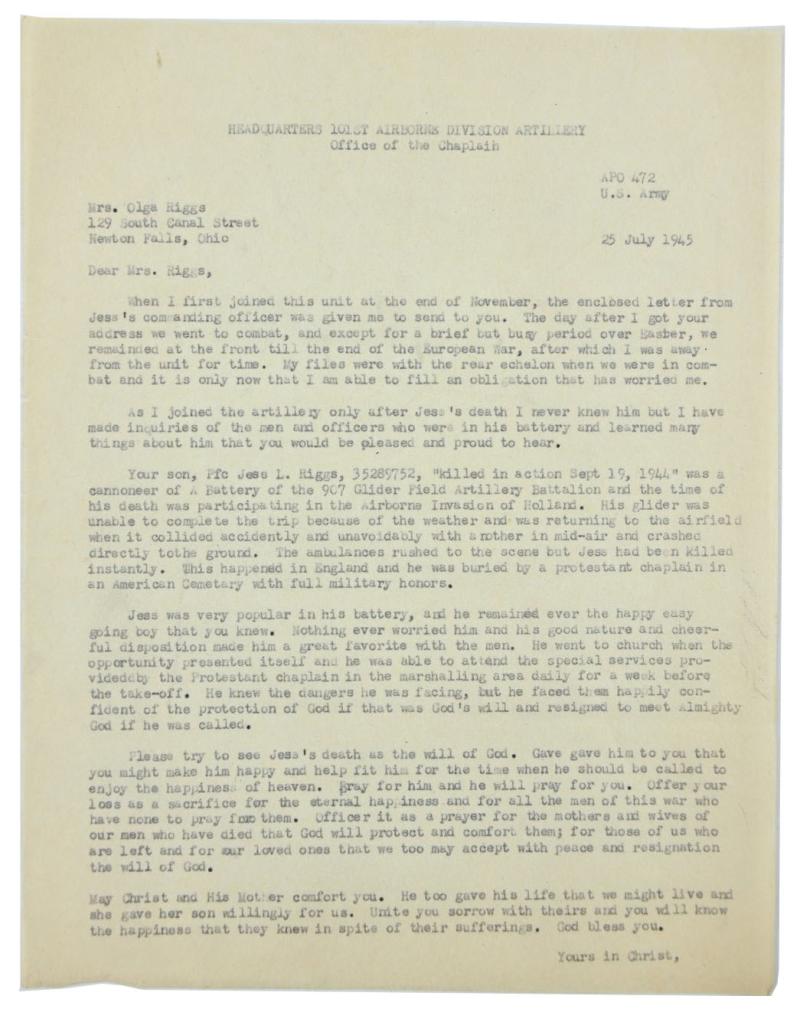
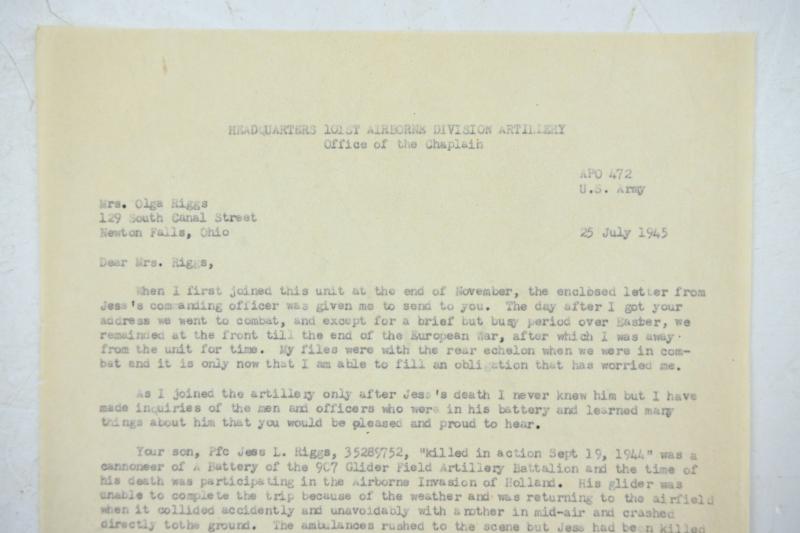
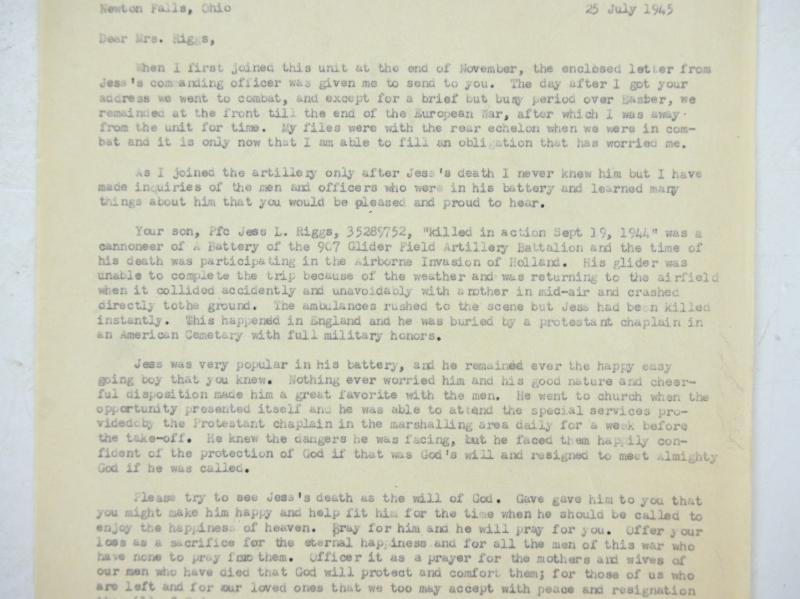
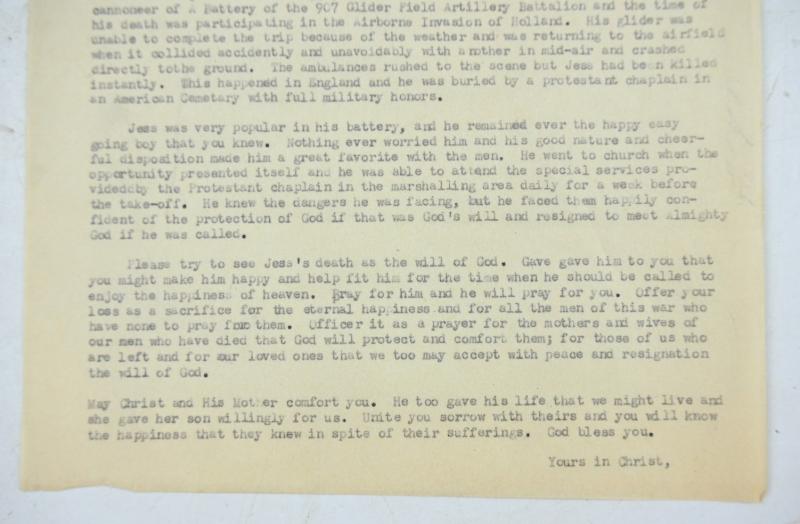
US WW2 Chaplain Letter 101st Airborne Division Mother of Jess L. Riggs
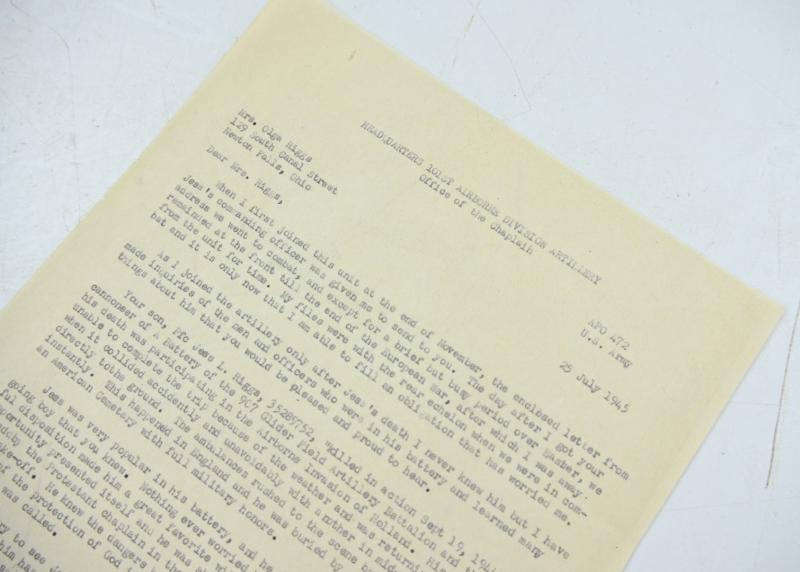
In a very nice condition a written letter by the 101st Airborne Division Artillery Chaplains Headquarters (mostlikly Selwyn Thorne) addressed to the Mother of Jess Leroy Riggs in July 1945.
On Sunday 17th September 1944 the allies launched their invasion of Holland, codenamed 'Market Garden'. The 436th Troop Carrier Group at Membury was heavily involved, dropping paratroopers from the 101st Airborne Division near Zon on D-Day, and towing gliders to landing zones in the Eindhoven area on D+1 and D+2.
Men from the 1st Battalion, 327th Glider Infantry Regiment, 907th Field Artillery Battalion and 326th Engineers were scheduled to fly the final D+2 mission and were waiting in company with their glider pilots - tension was high.
Bad weather seriously disrupted the missions flown on the 19th (D+2), but of the 41 gliders in the first serial most were delivered to their landing zones on schedule. However the second serial, consisting of 40 CG4A gliders and their tug aircraft, had to abandon the mission and return to base. The aircraft had been flying through a solid bank of cloud and for most of the journey the glider pilots were unable to see their tow planes. The call to return was received by the formation midway across the English channel.
Because of a serious shortage of glider pilots the CG4As were being flown without co-pilots. As the aircraft and glider combinations returned to Membury so the gliders would, one by one, break from their tow planes and manoeuvre into position, before landing on the grass infield of the aerodrome.
It was during this part of the aborted mission, at about 16:10 hours, that two gliders from the 82nd Troop Carrier Squadron collided. Both aircraft were on their downwind leg when they tragically came together, falling into a field close to Membury's base hospital. Both gliders were carrying men, equipment and supplies from the 327th Glider Infantry Regiment, 101st Airborne Division, and all eight occupants died instantly upon impact with the ground. The official crash report stated that 'although exactly what happened is unknown, visibility was good at the time and carelessness on one or other (of the pilots) part caused their deaths'. As they approached the field under a low, threatening ceiling, Second Lt. Robert Dopita, the co-pilot of one of the tugs, saw a tragic scene. Two Waco gliders that had released ahead of his plane and were now flying just below him at an altitude of less than 700 ft. suddenly turned and rammed head on. For a split second the two intermingled gliders seemed to hang in the air and then broke apart. A Jeep - its driver still sitting rigid at the wheel and his passenger slumped beside him - tore out the front of one of the gliders and tumbled to the ground. Bodies spilled out from the wreckage like toy soldiers out of a great box, turning over and over, arms and legs outspread as they fell. The two gliders crashed a short distance apart, and one of them burst into a brilliant white flame from the phosphorous shells it had been carrying.
Listed below are the names of those who lost their lives:-
CG4A glider serial number 42-79263
Pilot - F/O Kenneth. B. Hinkel
Passenger - Cpl. Stanley. A. Cynkar (907th GFAB)
Passenger - Pfc. George. W. Hilton (907th GFAB)
Passenger - Pvt. Jess. L. Riggs (907th GFAB)
CG4A glider serial number 42-56215
Pilot - 2nd Lt. Adolf Riscky
Passenger - Sgt. R. A. Dickman (907th GFAB)
Passenger - Pfc. Dan McFarlan (907th GFAB)
Passenger - Pvt. Ernest McMurty (907th GFAB)
Extract from "The Glider Gang", by Milton Dank.
Code: 86367
150.00 EUR